My home Internet connection is a VDSL/FTTC (fibre to the cabinet) which comes over the telephone line into a BT master socket which has an ADSL filter and requires a modem. The modems are now usually built into the BT Home/Smart Hub CPE (Customer-premises equipment) but I still use a Huawei HG612 standalone modem as I don’t particularly like the CPE I was given. So I need a router to talk PPPoE to the modem and also firewall, route and NAT my home lan traffic to the Internet. I used a pair of Linksys WRT3200ACM devices: one as a router and wireless access point and the other as just a wireless access point. However while I was quite happy with them, the overall experience was not great: Ring devices would not connect, Tapo devices would not upgrade firmware and the overall signal quality around the house was not very good. So I upgraded to some Aruba Mesh wireless access points, which turned out to be great. However this left most of the functionality of the WRT3200ACM unneeded in what is quite a large physical footprint, also I don’t want to overload the device by turning my internet router into a NAS. Thus I needed to find a replacement device that just does the routing. Also with the new access points I also changed to a managed network switches with vlans to allow guest wifi, an untrusted iot network, etc. Thus the new device could just be a single port router on a stick with a single trunk link.
When running the Gnome Desktop Environment on Debian there is a secrets tool that automatically runs called Gnome Keyring. This tool provides multiple functions:
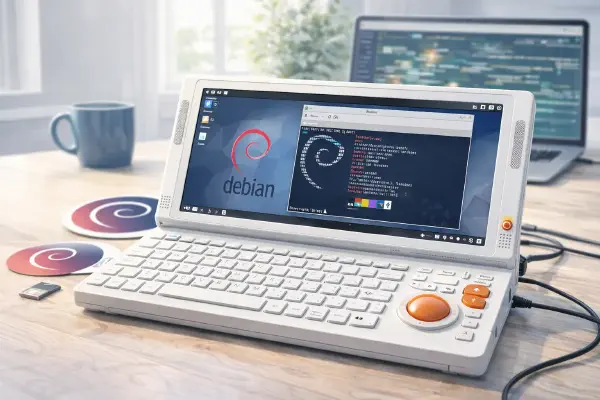
I recently found out about DevTerm Kit R-01 via Bryan Lunduke. I’ve been interested in RISC V for ages and so far have resisted buying any dev boards as they would just sit in boxes. However because this is an entire portable computer it’s a great way to play, there is hope it can become a useful piece of kit, so I immediately decided to get one.
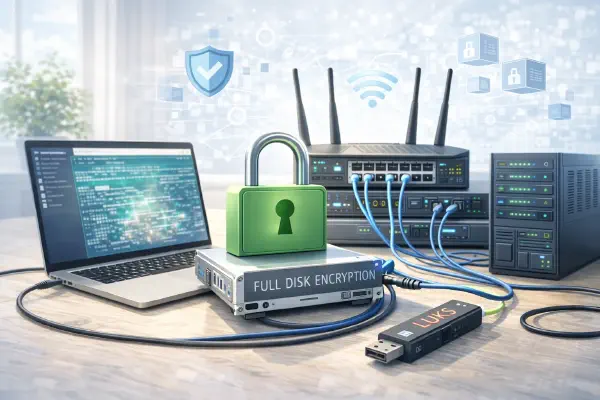
Recently I wanted to see if I could make my public cloud-based Linux infra more secure via LUKS (Linux Unified Key Setup) disk encryption. I realise that one must fully trust one’s cloud provider, as they have access to the hardware. However it would be nice to know that data is encrypted when stored on disk. This does not mitigate against a very bad cloud provider, as ultimately if they are determined enough they can get at the data. However implementing some sort of encryption does offer some protection against reading the data if disks are reused and certainly makes the barrier much higher for access casually.
Look at Debian Buzz running on bochs:
I use Nagios for monitoring. Up to recently I used a regular modem to send sms text messages to various people when systems are going wrong. The way this works is by using smsclient which dials up to a TAP server. [TAP] (http://en.wikipedia.org/wiki/Telelocator_Alphanumeric_Protocol) is a fairly archaic way of sending messages. It’s been fairly reliable however it has two major drawbacks, sending takes a long time and it’s limited to 160 characters. As far as I can tell it will not do long text messages, which are really just multiple short message combined together in a special way.
Grab: debian-bo.img.bz2 $ bunzip2 debian-bo.img.bz2 $ sudo qemu-system-i386 -hda debian-bo.img -net nic,model=ne2k_isa -net tap $ sudo brctl addif virbr0 tap0 Username: root, Password: password Edit /etc/init.d/network to configure network